
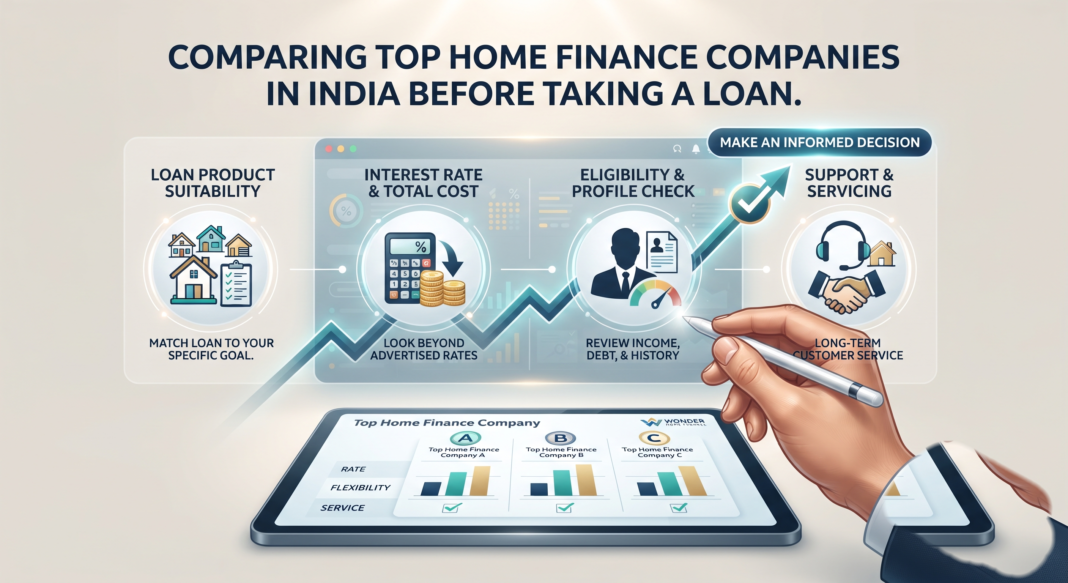

How to Choose and Compare a Top Home Finance Company in India
Choosing the right housing finance provider is one of the most important decisions in your homeownership journey. With multiple lenders offering different home loan products, interest rates, repayment options and eligibility criteria, comparing companies only on the basis of the advertised interest rate may not give you the complete picture.
If you are searching for a top home finance company in India, the better approach is to compare lenders according to your financial profile, property requirements and long-term repayment capacity. The right lender is not necessarily the company offering the lowest headline rate. It is the provider whose loan product, eligibility criteria, repayment structure, charges and customer service are suitable for your circumstances.
1. Start With the Home Loan Product You Actually Need
Before comparing home finance companies, identify why you need the loan. Your requirements can vary depending on whether you are buying a property, constructing a house, renovating an existing home or extending your current living space.
Match the Loan Product to Your Requirement
Common housing finance requirements include:
- Home Purchase Loan: For purchasing an eligible residential property.
- Home Construction Loan: For constructing a house on a plot you own.
- Home Improvement Loan: For eligible repairs, renovation or improvement work.
- Home Extension Loan: For adding rooms or expanding an existing home.
- Home Loan Balance Transfer: For transferring an existing home loan to another lender, subject to applicable terms.
Once you identify your requirement, compare lenders that offer the relevant loan product and review the applicable terms.
2. Look Beyond the Interest Rate
Interest rate is an important part of any home loan because it affects your repayment cost. However, selecting a lender based only on the lowest advertised rate can be misleading.
Compare the Complete Cost of the Loan
When evaluating different home finance companies, consider:
- Applicable interest rate
- Loan amount
- Repayment tenure
- Processing fee
- Administrative or documentation charges
- Legal and technical verification charges
- Prepayment or foreclosure terms, where applicable
- Other applicable charges
The total borrowing cost depends on the overall loan structure, not just the advertised interest rate.
Therefore, compare the terms applicable to your loan amount, profile and repayment period before making a decision.
3. Use a Home Loan EMI Calculator
Your monthly EMI should fit comfortably within your household budget.
Instead of deciding how much you can borrow first, consider how much you can reasonably afford to repay each month.
Test Different EMI Scenarios
A home loan EMI calculator can help you estimate your monthly repayment by changing:
- Loan amount
- Interest rate
- Loan tenure
For example, increasing the loan tenure may reduce your monthly EMI, but it can increase the total interest payable over the loan period. Similarly, reducing the loan amount can lower both the EMI and the overall interest burden.
Using an EMI calculator before applying can help you compare different borrowing scenarios and select a repayment structure that better suits your budget.
4. Check Your Home Loan Eligibility
Every housing finance provider may have its own eligibility criteria. Your eligibility can depend on factors such as:
- Age
- Income
- Employment or business profile
- Credit history
- Existing financial obligations
- Repayment capacity
- Property-related requirements
Checking your eligibility before applying can help you establish a realistic borrowing range.
Review Your Existing Financial Obligations
Before taking a new home loan, calculate your current monthly commitments, including existing loan EMIs and other significant financial obligations.
If a large portion of your income is already committed to debt repayment, taking on a high additional EMI may reduce your financial flexibility.
A realistic assessment of your existing commitments can help you determine a more suitable home-buying budget.
5. Consider the Property Being Financed
A home loan decision depends not only on your financial profile but also on the property you intend to finance.
Check Property Documentation
Before finalising a property, conduct appropriate due diligence and ensure that the required property documents are available and in order.
Depending on the lender and transaction, property documents may be reviewed during the legal and technical assessment process.
A property that appears affordable but has documentation or verification issues can potentially cause delays in the financing process.
Where appropriate, buyers may also seek independent professional advice regarding property documentation before proceeding with the transaction.
6. Compare Documentation and Loan Processing
The application process is another factor worth considering when comparing home finance companies.
Ask prospective lenders about:
- Personal and identity documents
- Address proof
- Income-related documents
- Bank statements
- Property documents
- Verification requirements
- Approval process
- Disbursement process
Having the required documents ready can make the application process more organised.
However, documentation requirements may vary depending on the applicant’s profile, property and lender’s current policies.
7. Understand Processing Fees and Other Charges
The cost of a home loan can include charges in addition to interest.
Before submitting an application, understand the applicable:
- Processing fees
- Administrative charges
- Documentation charges
- Legal and technical verification charges
- Prepayment or foreclosure-related charges, where applicable
- Late payment or penal charges
- Other applicable service charges
Do not rely solely on verbal information. Review the lender’s applicable fee schedule and loan documentation before accepting the offer.
8. Evaluate Customer Service and Long-Term Support
Getting a home loan approved is only one part of the borrowing journey. Since a home loan can remain active for many years, post-disbursement service is also important.
Look for Accessible Borrower Support
Consider how easily you can:
- Access your loan account information
- Obtain repayment details
- Raise service requests
- Get assistance with account-related queries
- Communicate with the lender when required
Accessible customer support can make loan servicing more convenient throughout the repayment period.
9. Compare Home Finance Companies Using a Structured Framework
Instead of comparing lenders randomly, use a consistent checklist.
| Evaluation Factor | What to Analyse | Why It Matters |
|---|---|---|
| Loan Product | Purchase, construction, improvement, extension or balance transfer | Ensures the lender offers the product you need |
| Interest Rate | Applicable rate and rate structure | Influences borrowing cost |
| Loan Amount | Amount you may be eligible for | Helps determine whether your funding requirement can be met |
| EMI & Tenure | Monthly repayment and repayment period | Helps assess affordability |
| Eligibility | Income, age, credit profile and other criteria | Determines potential borrowing eligibility |
| Processing Fee | Applicable processing charges | Adds to the cost of obtaining the loan |
| Other Charges | Legal, technical and service-related charges | Helps identify the complete cost |
| Documentation | Personal, income and property documents | Helps you prepare for the application process |
| Approval Process | Verification and disbursement steps | Helps set realistic expectations |
| Customer Service | Pre- and post-disbursement support | Important for long-term loan servicing |
| Repayment Terms | Applicable repayment and prepayment conditions | Helps you understand your long-term obligations |
This framework allows you to compare the overall home loan offering rather than selecting a lender because of one attractive feature.
10. Avoid Common Mistakes When Choosing a Home Finance Company
Choosing Only the Lowest Interest Rate
A lower advertised rate does not automatically mean the most suitable loan. Consider the complete cost and applicable terms.
Borrowing the Maximum Amount Available
Loan eligibility and loan affordability are not the same thing. Borrow only an amount that fits your long-term repayment capacity.
Ignoring Existing Debt
Existing EMIs and financial commitments should be considered before taking on another long-term obligation.
Not Checking Property Documents
Property-related issues can affect the financing process. Review the relevant documents and complete appropriate due diligence before committing to a property.
Ignoring Other Charges
Processing, legal, technical and other applicable charges can add to the overall cost of borrowing.
Comparing Only One Lender
Comparing multiple suitable options can give you a clearer understanding of available products, rates, eligibility criteria, charges and service levels.
Finding a Suitable Home Finance Partner in India
When searching for a top home finance company in India, focus on suitability rather than relying only on rankings, labels or advertised rates.
Wonder Home Finance provides housing finance options for different residential requirements, including home purchase, construction, home improvement, home extension and balance transfer.
You can explore its housing finance offerings and tools through the official Wonder Home Finance website.
Make Your Home Loan Decision With a Long-Term View
A home loan is a long-term financial commitment. The decision you make today can influence your household budget for many years.
Before selecting a housing finance provider, compare:
Loan Product + Interest Rate + EMI + Tenure + Eligibility + Charges + Documentation + Property Requirements + Customer Service
This broader comparison can help you identify an option that is appropriate for your financial circumstances rather than simply choosing the lender with the most attractive headline offer.
Frequently Asked Questions
What should I compare before choosing a home finance company in India?
Compare the loan product, interest rate, loan amount, EMI, tenure, eligibility criteria, processing fees, other applicable charges, documentation requirements, repayment terms and customer service.
Is the lowest home loan interest rate always the best option?
No. The overall cost and suitability of a home loan also depend on the loan amount, tenure, applicable fees, repayment conditions and your financial profile.
How can a home loan EMI calculator help me?
A home loan EMI calculator can help you estimate your monthly repayment by entering the loan amount, interest rate and tenure. You can test different combinations to understand how your EMI may change.
What factors can affect home loan eligibility?
Eligibility may depend on factors such as age, income, employment or business profile, credit history, existing financial commitments, repayment capacity and property-related requirements.
Why should I check property documents before taking a home loan?
Property documents may form part of the lender’s legal and technical assessment. Identifying documentation issues early can help reduce the possibility of delays during the financing process.
Should I compare more than one home finance company?
Yes. Comparing multiple suitable lenders can help you understand differences in loan products, interest rates, eligibility, charges, repayment terms and customer service.
What is more important: EMI or interest rate?
Both are important. The interest rate affects the cost of borrowing, while the EMI determines the monthly repayment burden. You should consider both along with the loan tenure and total borrowing cost.
Should I choose a bank or a housing finance company?
Both may offer home loan solutions. Instead of choosing based solely on the type of institution, compare the loan product, eligibility criteria, interest rate, charges, repayment terms and service according to your requirements.
Conclusion
Choosing a top home finance company in India should involve more than comparing advertised interest rates.
A well-informed borrower should evaluate the loan product, overall borrowing cost, EMI affordability, eligibility criteria, existing financial commitments, property documentation, applicable charges and long-term customer support.
Before applying, compare the options available to you and select a housing finance provider whose loan structure and repayment requirements align with your financial capacity and homeownership goals.
Disclaimer
Home loan interest rates, eligibility criteria, processing fees, charges, loan products and other terms may vary depending on the lender, applicant profile, property and prevailing policies. Applicants should verify the latest applicable terms, eligibility requirements, charges and documentation directly with the respective financial institution before applying for a home loan.

